What Is an Industrial Panel PC? Components, Types and Applications
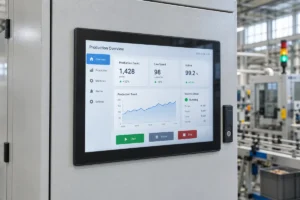
An industrial panel PC is a computer with a built-in display, usually a touchscreen, designed for …
Eagle Touch Engineering Team
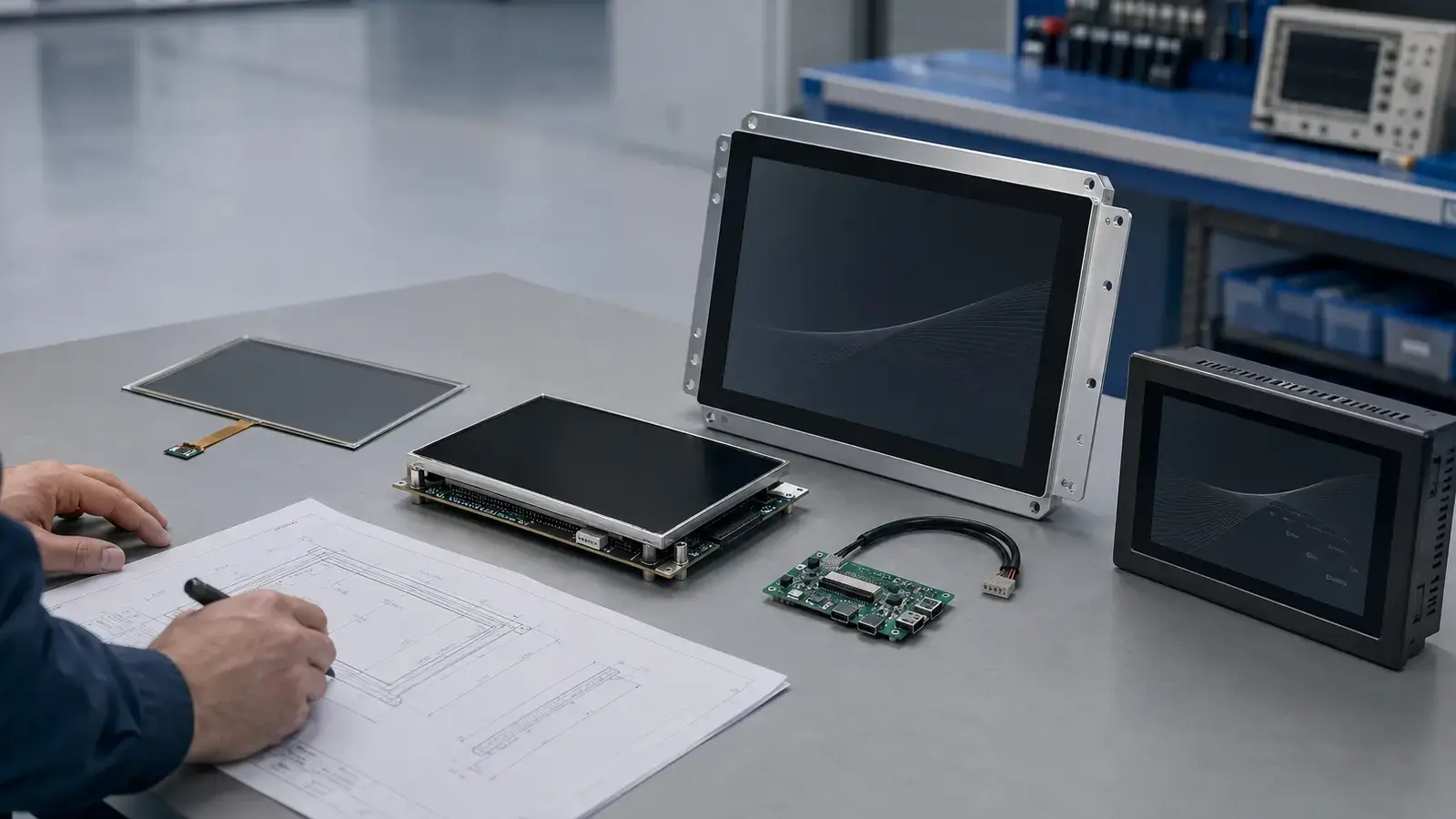
There is no single “best” touch screen manufacturer. There is only the supplier that best fits the product you are building.
A kiosk manufacturer looking for a standard open-frame monitor is not buying the same thing as a medical equipment company that needs a custom touch sensor. An EV charger project may require thick cover glass, wet-touch tuning and optical bonding, while a factory retrofit may depend on a long-life resistive panel and an older serial interface.
That difference matters. Some companies specialize in touch sensors. Some supply controllers and bonded LCD modules. Others build complete touch monitors or panel PCs. Comparing them as if they sold the same product leads to poor supplier decisions.
This guide compares ten active industrial touch screen manufacturers by product scope, technical focus and OEM suitability. It is intended for engineers, product managers and procurement teams—not for buyers looking for consumer tablets or replacement phone screens.
Selection note: The companies below were selected from manufacturers with verifiable industrial or professional touch products available in August 2026. The numbering is for navigation, not a market-share ranking. Product availability and customization terms should always be confirmed for a specific project.
| Manufacturer | Base | Supplier Type | Main Product Scope | Best Fit |
|---|---|---|---|---|
| Elo Touch Solutions | United States | Platform product manufacturer | Open-frame monitors, touch monitors, touch computers | Standardized commercial and OEM deployments |
| DMC | Japan | Touch technology and HMI manufacturer | Resistive and PCAP sensors, controllers, touch modules, HMI products | Industrial equipment and long-life resistive applications |
| AMT | Taiwan | Touch sensor and display solution manufacturer | Resistive and PCAP touch, controllers, bonding, touch displays | Industrial, medical, transport and outdoor equipment |
| Nissha | Japan | Film touch sensor manufacturer | Film-based capacitive sensors and integrated modules | Automotive, curved interfaces and higher-volume programs |
| SCHURTER | Switzerland | Custom input system manufacturer | PCAP, resistive touch and complete HMI integration | Regulated and technically demanding custom HMI projects |
| DISPLAX | Portugal | PCAP specialist | PCAP sensors, controllers and large-format touch solutions | Kiosks, digital experiences and rugged PCAP projects |
| A D Metro | Canada | Industrial touch sensor manufacturer | Standard and rugged resistive touch, PCAP solutions | Harsh industrial, military and legacy input applications |
| GZE | Taiwan | Touch panel and integration manufacturer | PCAP, resistive, metal mesh, optical bonding, open-frame displays | Industrial touch panels and programs transitioning from Gunze |
| Higgstec | Taiwan | Touch panel and module manufacturer | PCAP, 5-wire resistive, true-flat touch panels and touch display modules | Industrial, medical, rugged and transportation equipment |
| Eagle Touch | China | OEM touch display manufacturer | Custom touch panels, industrial monitors, panel PCs and bonding | Small-to-medium custom OEM programs |
The table is a starting point, not a scorecard. A sensor manufacturer may offer deeper touch technology than a monitor brand, while a complete monitor supplier may remove far more integration work from your project.
Elo Touch Solutions is one of the most established names in commercial touch systems. Its portfolio includes open-frame touch displays, desktop monitors, interactive signage and touch computers. The open-frame range is designed for integration into kiosks, machines and equipment enclosures, with drawings and established product platforms available for OEMs and system integrators.
Best fit: Projects that value a standardized platform, broad documentation and an established commercial ecosystem—particularly retail, self-service, hospitality, healthcare and kiosk deployments.
What to confirm: Elo is strongest when an existing platform fits the enclosure and system architecture. If a project needs a non-standard cover glass outline, special FPC position or a completely redesigned mechanical structure, confirm the available customization scope before selecting a model.
DMC is a Japanese touchscreen and HMI manufacturer with a strong industrial focus. Its current product range covers resistive touchscreens, projected capacitive touchscreens, controllers and touchscreen modules, as well as industrial monitors and panel computers.
DMC remains particularly relevant where resistive technology is still the correct engineering choice. That includes equipment operated with a stylus, legacy control systems and applications that prioritize pressure input or noise immunity over smartphone-style gestures. The company also offers PCAP solutions for modern interfaces.
Best fit: Factory equipment, measurement instruments, embedded controls, medical equipment and long-lifecycle products that need industrial touch components rather than a consumer display.
What to confirm: Identify whether the project needs a sensor, sensor-plus-controller, bonded module or complete HMI. These are different sourcing scopes and should not be quoted as interchangeable products.
AMT is based in Taiwan and supplies resistive and projected capacitive touchscreens, PenMount controllers, touch display solutions, open-frame monitors and optical bonding services. Its products are positioned for industrial, medical, outdoor, transportation and commercial applications.
AMT is one of the more complete suppliers in this list because it covers both touch components and integrated display solutions. Its PCAP range includes options intended for wide temperature, UV exposure, glove operation and electrically noisy environments. Actual performance still depends on the selected controller, cover glass, grounding and final assembly.
Best fit: Equipment manufacturers that need industrial touch technology, controller support and the option to move from a separate sensor to a bonded LCD assembly.
What to confirm: Ask which functions are standard and which require project-specific tuning. “Glove touch” and “wet touch” are not universal settings; glove material, thickness, water behavior and enclosure grounding all affect the result.
Nissha specializes in film-based capacitive touch sensors. Its official product information emphasizes high optical performance, roll-to-roll production and module integration from the sensor and FPC through cover panel and display lamination.
Film sensors are especially useful when low weight, thin construction or curved surfaces matter. Nissha also addresses automotive and industrial reliability, polarized-sunglasses visibility, glove input and operation with water droplets through application-specific design and tuning.
Best fit: Automotive interfaces, handheld terminals, curved surfaces and higher-volume products where film-based sensor technology offers a clear mechanical advantage.
What to confirm: Nissha’s capabilities are broader than a typical small-batch touch panel factory. Buyers should discuss development volume, qualification process, tooling and mass-production expectations early.
SCHURTER develops custom input systems including PCAP touchscreens, resistive touchscreens, capacitive switches, membrane switches and complete HMI assemblies. Its PCAP work can include custom sensor design, controller tuning, front glass, display integration, electronics and housing.
This makes SCHURTER relevant when the touchscreen is part of a larger human-machine interface rather than a standalone component. The company also addresses requirements such as EMC, glove use, temperature range and water rejection in application-specific designs.
Best fit: Industrial, medical, aerospace and other specialized HMI projects where documentation, qualification and integration are as important as the touch sensor.
What to confirm: Define the expected deliverable before requesting a quotation. A custom front panel, a touch-display assembly and a complete HMI are very different engineering programs.
DISPLAX is a Portugal-based manufacturer focused on projected capacitive touch technology. It offers standard and custom PCAP sensors, controllers and interactive touch solutions from 7 inches up to 135 inches, including foil-on-glass and large-format products.
Its portfolio covers two areas that do not always come from the same supplier: very large interactive surfaces and smaller rugged PCAP systems for industrial, medical, vending and outdoor applications. For buyers replacing legacy Zytronic systems, DISPLAX also markets a controller solution designed for that transition.
Best fit: Large kiosks, museums, interactive tables, retail installations and projects that specifically need advanced PCAP rather than resistive touch.
What to confirm: Large-format touch design is highly dependent on glass construction, controller location, cable routing, display noise and installation. Validate the actual assembly, not only a sensor on a laboratory bench.
A D Metro is a Canadian touch technology manufacturer supplying OEMs and system integrators. Its product focus includes PCAP, standard resistive and its reinforced ULTRA resistive technology for demanding industrial applications.
A D Metro is notable because it continues to develop resistive technology for environments where pressure input, contaminants, heavy gloves or electromagnetic conditions make PCAP less attractive. Resistive touch is not obsolete when the operating method genuinely favors it.
Best fit: Industrial controls, military equipment, transportation, marine systems and replacement programs that need durable pressure-operated touch input.
What to confirm: Separate the capabilities of a standard resistive sensor from a reinforced specialty product. Surface durability, sealing and chemical resistance depend on the exact construction, not on the word “resistive” alone.
GZE is the successor to Gunze’s touch panel business, which was transferred to First International Computer at the beginning of 2025. Its current range includes PCAP touch panels, glass-sensor touch panels, resistive touchscreens, metal-mesh solutions, optical bonding and open-frame touch displays.
This is an important distinction for buyers searching older Gunze part numbers. Gunze is historically well known in industrial touch, but current projects and continuity discussions should be directed to the active business rather than treating Gunze as an unchanged 2026 manufacturer.
Best fit: Industrial HMI, medical devices, outdoor terminals and OEMs that need touch panels, bonding or continuity from legacy Gunze programs.
What to confirm: For an existing Gunze design, provide the complete part number, drawing, controller and host interface. Brand continuity does not automatically mean every old part remains a drop-in replacement.
Higgstec was established in 2002 and is headquartered in Taiwan. The company manufactures projected capacitive, 5-wire resistive and true-flat touch panels, and also supplies touch display modules that integrate the touch panel with an LCD.
Its product range is aimed at professional equipment rather than consumer replacement screens. Higgstec presents solutions for industrial, medical, rugged, transportation, automotive and marine applications, with options addressing thick gloves, moisture, impact-resistant glass and electromagnetic interference.
Best fit: Equipment manufacturers that need a custom touch panel or touch-and-LCD module for industrial controls, medical devices, rugged terminals, vehicles or transportation systems.
What to confirm: Determine whether the quotation covers only the touch panel or a complete touch display module. Confirm the LCD model, controller, bonding method, cover glass, interface and required environmental tests; application claims do not mean that every standard model has the same configuration.
Eagle Touch is a China-based OEM manufacturer of custom PCAP and resistive touchscreens, industrial touch monitors and industrial panel PCs. Its project scope can include custom cover glass, FPC and connector changes, controller matching, touch tuning, air or optical bonding and mechanical integration.
The company is positioned between a touch component supplier and a complete industrial display manufacturer. A project can start with a separate touch panel, an LCD drawing or an existing enclosure and develop into a bonded touch-display module, open-frame monitor or panel-mount monitor.
Best fit: Small-to-medium OEM programs for industrial equipment, EV chargers, kiosks, automation systems and custom display projects where communication speed and mechanical flexibility matter.
What to confirm: Custom work should begin with the LCD model or drawing, cover-glass requirements, interface, environment, sample quantity and expected production volume. A clear input package prevents repeated drawing revisions.
Disclosure: Eagle Touch publishes this guide and is included because it supplies products in the category being compared. It has been described using the same product-scope and project-fit criteria as the other manufacturers.
A credible manufacturer list must be maintained. Brand recognition alone is not proof that a company is still producing the same products.
Zytronic was once a major name in rugged projected-capacitive touch systems, but its manufacturing business closed in May 2025 during the company’s wind-down. It should not be presented as an active 2026 touchscreen manufacturer. Buyers supporting installed Zytronic systems should instead investigate remaining channel support or validated replacement technology.
Gunze is another example, but for a different reason: its touch panel operation did not simply disappear. The business was transferred, and GZE now presents itself as the active successor. For procurement teams, this changes where product availability and lifecycle questions should be directed.
The lesson is simple: a manufacturer list without current product verification is only a list of familiar names.
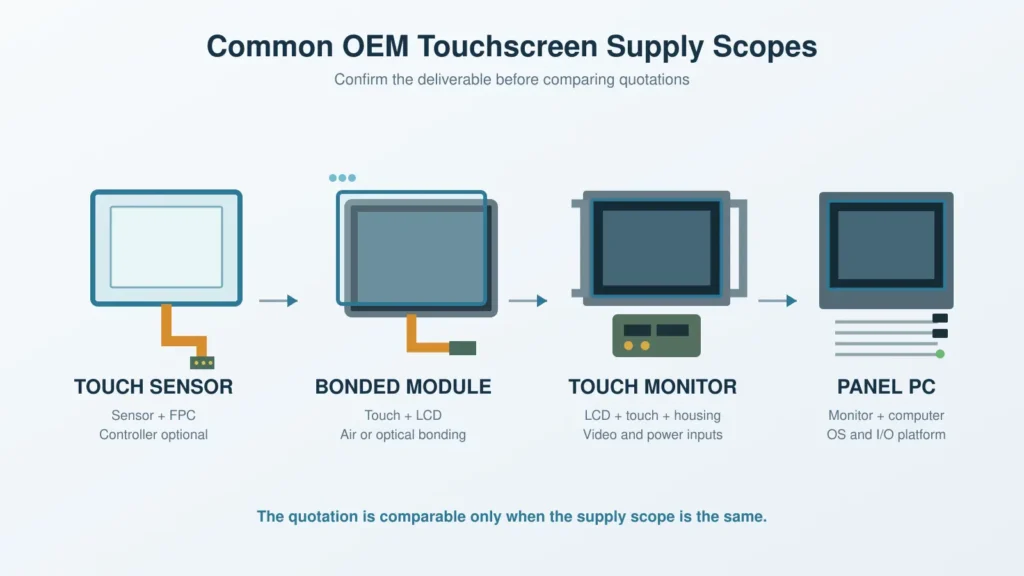
Before comparing suppliers, define what you actually need to purchase.
| Required Deliverable | What It Includes | Suitable Supplier Type |
| Touch sensor | Sensor and FPC, sometimes without controller | Touch panel manufacturer |
| Touch assembly | Sensor, cover glass, FPC and controller | Custom touch manufacturer |
| Bonded display module | Touch assembly bonded to the LCD | Touch display and bonding supplier |
| Open-frame or panel-mount monitor | LCD, touch, AD board, housing and video inputs | Industrial monitor manufacturer |
| Panel PC | Touch display, enclosure, motherboard and operating platform | Industrial panel PC manufacturer |
If the required scope is unclear, quotations will not be comparable. One supplier may quote a sensor while another quotes a complete monitor, and the lower price will appear attractive only because the product is incomplete.
Confirm the LCD active area, viewing area, sensor outline, cover-glass outline, thickness, FPC direction, connector position and mounting clearance. A touch panel can function perfectly and still be unusable because it does not fit the enclosure.
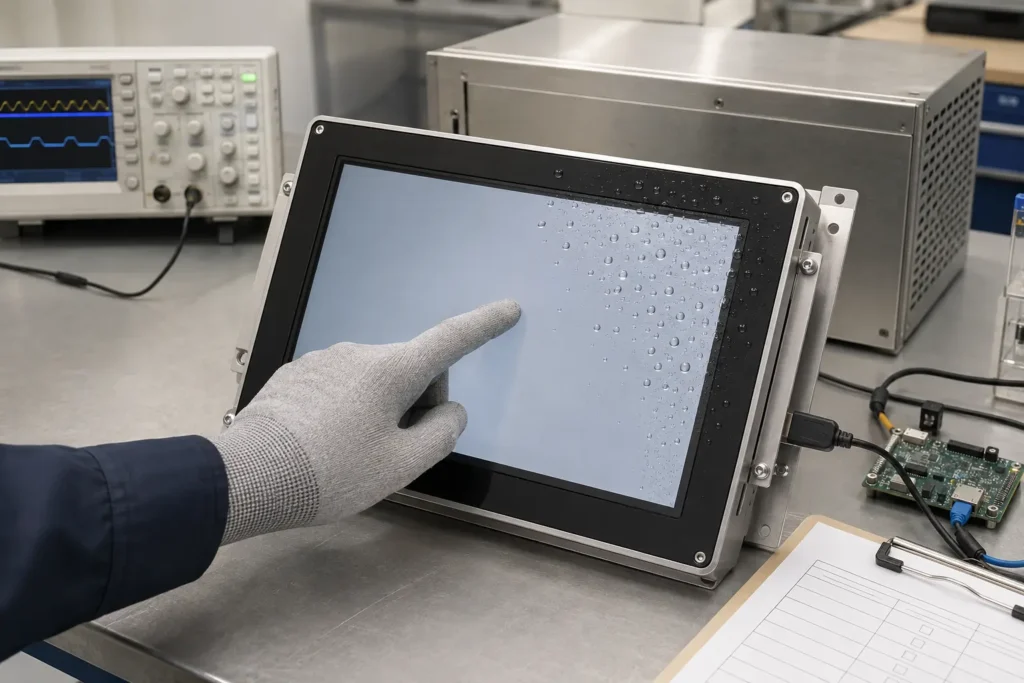
“Supports gloves” is not a complete requirement. State the glove material and thickness. For wet operation, define whether the system must reject droplets, track a finger through droplets or continue operating under flowing water. These are different behaviors.
The LCD, power supply, charger, grounding, USB cable and metal enclosure can all influence PCAP performance. Controller tuning should therefore be validated with the final or representative assembly.
Outdoor readability is not created by the touchscreen alone. LCD brightness, ambient contrast, reflections, cover glass treatment and the air gap all matter. Optical bonding can reduce internal reflection, but it does not replace thermal management, UV-resistant materials or a properly sealed enclosure.
A touch sensor by itself does not give a finished product an IP65 rating. The front seal, bezel, gasket, bonding method, housing and assembly process must be evaluated together. The same principle applies to IK impact ratings: glass thickness alone is not enough to certify the complete unit.
Ask how the supplier handles controller changes, LCD discontinuation, material substitutions and firmware revisions. For a long-lifecycle industrial product, controlled change management may be more valuable than saving a few dollars on the first sample.
A useful RFQ does not need to be long, but it must remove the main unknowns. Send:
If the drawing is not ready, photographs, target dimensions and the LCD part number are usually enough for an initial feasibility review. Eagle Touch can review these details through its custom touch solution service.
There is no universal best manufacturer. Elo is a strong candidate for established monitor platforms; DMC, AMT, GZE, Higgstec and A D Metro provide touch-component or module options; Nissha specializes in film sensors; DISPLAX focuses on PCAP; SCHURTER develops custom HMI systems; and Eagle Touch focuses on flexible custom display integration. The right choice depends on the required deliverable, environment, volume and engineering scope.
Buy a touch panel when your team already controls the LCD, electronics and mechanical assembly. Choose a complete monitor when you want video inputs, power conversion, housing and mounting handled by one supplier. A bonded touch-display module is the middle option.
No. PCAP is generally preferred for multi-touch, a glass front and modern user interfaces. Resistive touch remains useful for pressure input, passive styluses, heavy gloves, certain high-noise environments and legacy equipment. Application requirements should decide the technology.
It can, with the correct sensor, controller, cover-glass thickness and firmware tuning. Performance must be defined and tested with the intended glove, water condition, LCD, power supply, grounding and enclosure. Wet-touch performance is not the same as waterproofing.
Test mechanical fit, touch accuracy, edge response, glove and wet behavior, startup, grounding, electrical noise, operating system compatibility and performance with the actual LCD and power supply. Do not approve mass production based only on a desktop touch test.
The largest manufacturer is not automatically the safest choice, and the lowest quotation is rarely the full answer.
For an OEM project, start by defining the product scope. Then compare suppliers on the parts of the project that can create field failures: mechanical fit, controller behavior, environmental performance, documentation and repeat supply.
If your project requires a non-standard cover glass, a specific LCD, optical bonding or a complete industrial monitor, send Eagle Touch the LCD drawing, target dimensions, environment and expected quantity. We can evaluate the structure before you commit to tooling or enclosure production.
An industrial panel PC is a computer with a built-in display, usually a touchscreen, designed for …
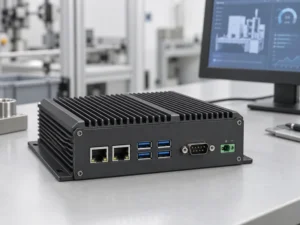
An embedded PC is a computer configured to work as part of a machine or larger …
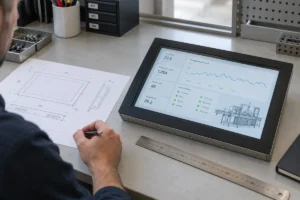
Start with the software the panel PC must run and the conditions it must fit. Then …
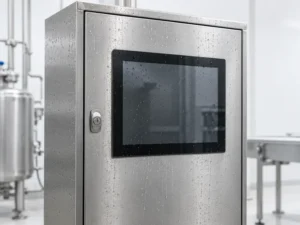
Choosing an industrial panel PC IP rating starts with two questions: what dust and water exposure …
Share your application, requirements, or current challenge. Our team will review the details and recommend a practical way forward.