Industrial Display Black Screen: 7 Causes, Fast Fix & How to Solve It Without Replacement
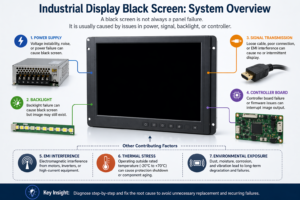
Quick Answer An industrial display black screen is typically caused by: Power supply instability LED backlight …
Many outdoor displays advertised as “1500–2000 nits” fail in direct sunlight.
Not because they lack brightness—but because they lack proper optical design.
In real deployments, reflection and internal optical losses often offset brightness gains, resulting in washed-out screens and reduced usability.
This is a common—and often costly—mistake in outdoor display selection.
This guide explains how to choose a sunlight readable monitor based on engineering considerations rather than marketing specifications.
For a broader overview of sunlight readable display design—including brightness, optical treatments, and system-level considerations—refer to:
→ Sunlight Readable Displays (2026): How to Avoid Costly OEM Mistakes in Outdoor Industrial Systems
A sunlight readable monitor typically requires ≥1000 nits brightness, optical bonding, low-reflectance surface treatment (AG/AR), and appropriate thermal design.
Brightness alone does not ensure visibility. Reflection control and optical structure determine actual readability under sunlight.
Many so-called “high brightness displays” focus on luminance output but do not adequately address reflection control, resulting in limited readability in outdoor conditions.
A sunlight readable monitor is a display system designed to maintain usable contrast and visibility under direct or high ambient light conditions.
It is not defined by brightness alone. Instead, readability depends on the balance between emitted luminance and reflected ambient light.
Typical characteristics include:

Brightness defines how much light the display emits.
Typical ranges:
However, increasing brightness without reducing reflection leads to higher power consumption with limited visibility improvement.
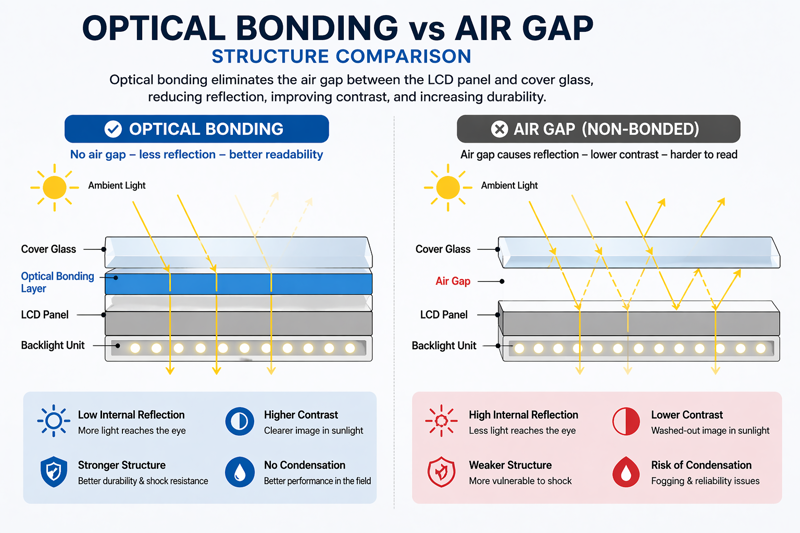
Optical bonding eliminates the air gap between the display panel and cover glass.
Engineering impact:
Measured impact observed in field and lab conditions:
In multiple deployments, bonded 1000-nit displays have demonstrated better usability than non-bonded 2000-nit configurations.
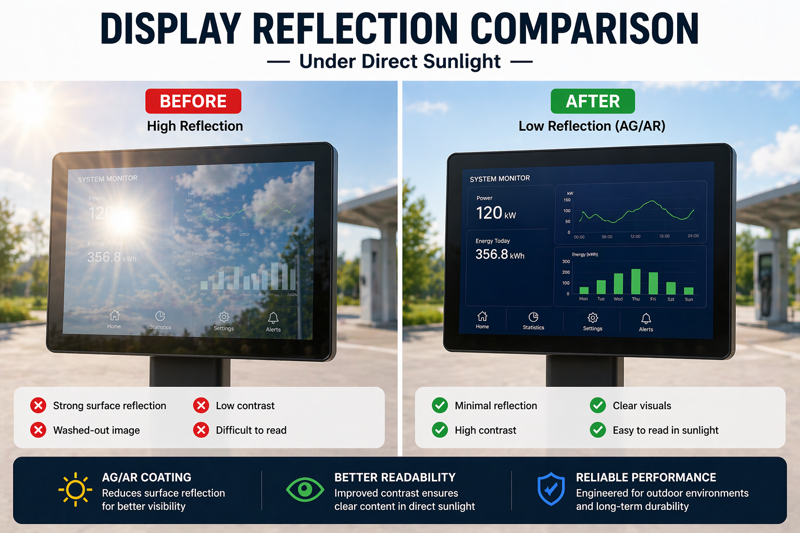
Surface reflection is a primary factor limiting readability.
Typical reflectance reduction:
~4% → ~1.5%
This improves perceived contrast under high ambient light.
High brightness increases heat generation.
Without proper thermal management:
Engineering approaches include:
Many displays are specified as “high brightness,” but this alone does not ensure sunlight readability.
| Feature | High Brightness Display | Sunlight Readable Monitor |
|---|---|---|
| Brightness | High (≥1500 nits) | ≥1000 nits (application dependent) |
| Optical Bonding | Optional | Required |
| Surface Treatment | Limited | AG + AR required |
| Reflection Control | Weak | Engineered |
| Outdoor Reliability | Uncertain | Designed for outdoor use |
A high brightness display without reflection control may remain difficult to read in direct sunlight.
When integrating a sunlight readable monitor, evaluate:
System mismatch between environment and display design is a common failure source.
Sunlight readable monitors are commonly used in:
Each application imposes different constraints on brightness, durability, and thermal design.
Common issues include:
These mistakes often lead to poor visibility or reduced system lifespan.
Direct sunlight → ≥1500 nits + optical bonding required
Behind protective glass → optical bonding is mandatory
High humidity or outdoor exposure → IP65+ with sealed structure
Interactive systems → PCAP touch with glove and wet support
Final Rule:
Brightness alone does not make a display sunlight readable.
Without optical bonding and effective reflection control, even a 2000-nit display may perform poorly in outdoor environments.
In many field deployments, insufficient optical design—not brightness—is the primary factor limiting readability.
Optical bonding typically increases display cost by approximately 15–30%.
However, incorrect display selection may result in:
In outdoor systems such as EV charging and kiosks, display readability directly affects usability and operational performance.
In OEM applications such as EV charging stations, kiosks, and industrial systems, display selection directly affects overall system reliability.
Field issues are often caused by mismatches between display design and deployment conditions rather than component defects.
Incorrect display selection in outdoor OEM projects may result in:
Early evaluation of optical bonding, thermal behavior, and environmental requirements can reduce redesign cycles and improve long-term system stability.
A sunlight readable monitor is appropriate when:
This solution may not be necessary when:
Sunlight readability is not defined by a single specification.
It is the result of coordinated design across brightness, optical structure, surface treatment, and thermal management.
Engineering evaluation should prioritize contrast performance and environmental reliability over nominal brightness values.
Before finalizing display selection:
For project-specific evaluation:
In outdoor systems, correcting an incorrect display selection after deployment typically requires significantly more cost and effort than making the right decision during initial design.
Q1: Is 2000 nits always better than 1000 nits?
Not necessarily. Without optical bonding and reflection control, higher brightness may not improve readability.
Q2: Why is optical bonding important?
It reduces internal reflection, improves contrast, and prevents condensation in outdoor environments.
Q3: Can indoor displays be used outdoors with enclosures?
Generally not recommended due to thermal and optical limitations.
Q4: What is the minimum requirement for sunlight readability?
Typically ≥1000 nits with optical bonding, AG/AR treatment, and IP65 protection
Quick Answer An industrial display black screen is typically caused by: Power supply instability LED backlight …
Introduction Industrial display flickering often appears unexpectedly in real deployments such as EV charging stations, factory …

Introduction Outdoor displays are designed for harsh environments, but outdoor industrial display overheating remains one of …

Introduction In OEM system design, touchscreen integration failures are often caused by incorrect assumptions about iOS …
Send your application details. We respond with configuration direction and next steps.