Industrial Display Black Screen: 7 Causes, Fast Fix & How to Solve It Without Replacement
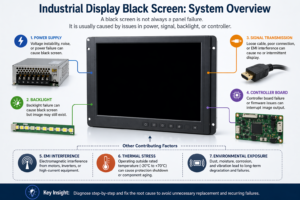
Quick Answer An industrial display black screen is typically caused by: Power supply instability LED backlight …
Choosing the correct IP rating for an industrial Panel PC is a common specification step, but it is frequently misunderstood in practice.
A higher IP rating is often assumed to indicate a more robust or longer-lasting system. In reality, over-specifying ingress protection can:
This guide explains the differences between IP65, IP67, and IP69K, and provides a practical framework for selecting the appropriate rating based on real deployment conditions.For a broader overview of industrial display systems and how Panel PCs fit into different architectures, see our guide to Industrial Panel PCs.
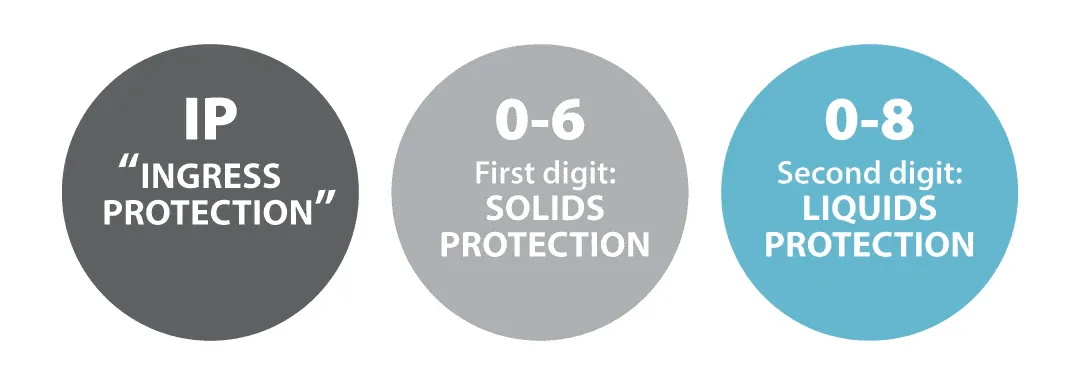
An IP (Ingress Protection) rating defines how effectively an enclosure prevents external contaminants from entering the system.
It consists of two digits:
In industrial Panel PCs, IP rating directly affects enclosure design, cooling strategy, and installation method.
Important:
IP rating only defines sealing performance. It does not indicate:
The differences between IP65, IP67, and IP69K are not only about protection level, but also about enclosure design constraints.
| Rating | Protection Level | Typical Environment | Design Impact |
|---|---|---|---|
| IP65 | Dust-tight + water jets | Factory automation | Low |
| IP67 | Dust-tight + temporary immersion | Outdoor / humid | Medium |
| IP69K | Dust-tight + high-pressure wash | Food & pharmaceutical | High |
Key observation:
Selecting a higher IP rating than required introduces mechanical and thermal constraints without improving actual system performance.
In industrial Panel PCs, the term “IP65” can refer to two different sealing strategies.
Engineering risk:
Some products are labeled as “IP65 Panel PC” while only the front panel meets the rating.
This distinction directly affects:
Misunderstanding this difference is one of the most common causes of incorrect IP specification in projects.
Higher IP ratings require tighter sealing, which reduces airflow.
As a result:
In sealed systems, thermal design becomes the primary engineering challenge.
A common assumption is:
Better sealing leads to better durability
In practice:
For 24/7 operation, thermal stability has a greater impact on reliability than ingress protection level.
Fully sealed systems introduce additional operational considerations:
For large-scale deployments, serviceability must be evaluated alongside IP rating.
In many industrial projects:
Typical reasons include:
Resulting issues:
Rule of thumb:
Select the minimum IP rating that satisfies actual environmental conditions.
IP rating should be evaluated as part of a broader system design.
Key considerations include:
IP rating is a design constraint, not a performance indicator.
For industrial Panel PCs:
The appropriate solution is not the highest IP rating, but the one aligned with the actual operating environment.
Our engineering team can help you evaluate the optimal IP rating based on:
👉 Get a tailored recommendation for your project — no over-specification, no unnecessary cost.
Q1: Does IP67 always perform better than IP65?
No. IP67 provides additional protection against immersion, but may introduce unnecessary thermal constraints for indoor applications.
Q2: Is IP69K required for all industrial environments?
No. It is only needed for high-pressure and high-temperature washdown scenarios.
Q3: Does a higher IP rating increase system lifespan?
Not necessarily. Poor thermal management in sealed systems can reduce lifespan.
Q4: How can I verify if a Panel PC is fully IP-rated?
Check whether the rating applies to the full enclosure or only the front panel.
Q5: Can a fanless Panel PC still achieve high IP rating?
Yes. Most high IP-rated systems use fanless designs. However, this increases reliance on passive heat dissipation, making thermal design critical.
Quick Answer An industrial display black screen is typically caused by: Power supply instability LED backlight …
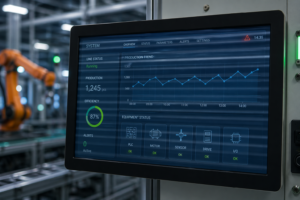
Introduction Industrial display flickering often appears unexpectedly in real deployments such as EV charging stations, factory …
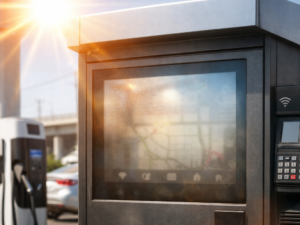
Introduction Outdoor displays are designed for harsh environments, but outdoor industrial display overheating remains one of …

Introduction In OEM system design, touchscreen integration failures are often caused by incorrect assumptions about iOS …
Send your application details. We respond with configuration direction and next steps.