Industrial Kiosk Display Design for Self-Service Systems

Introduction Self-service kiosks are widely deployed across transportation systems, EV charging infrastructure, retail automation, and public …
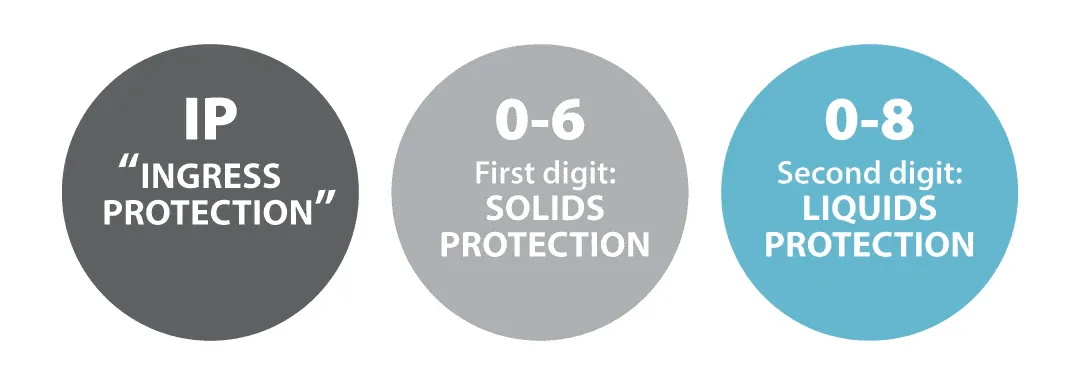
In industrial Panel PC projects, IP rating (Ingress Protection) is often specified early as a mandatory requirement — such as IP65 front protection or full IP65 enclosure.
However, from an engineering perspective, a higher IP rating does not automatically translate into better system reliability.
For Panel PCs designed for 24/7 operation, long lifecycle support, and controlled BOM management, IP rating should be treated as a design constraint, not a standalone performance target.
This article explains how IP rating affects thermal behavior, system stability, and long-term reliability, and highlights common pitfalls seen in industrial projects.
In industrial environments, IP rating primarily describes:
Typical requirements for Panel PC projects include:
⚠️ It is important to note:
IP rating does not define thermal performance, system lifespan, or serviceability.
Increasing IP rating almost always requires stronger sealing, which directly affects multiple system-level design factors.
As a result:
👉 As IP rating increases, thermal design becomes the dominant system limitation.
A common misconception is:
“Better sealing always improves durability.”
In reality:
For Panel PCs operating continuously,
thermal management often has a greater impact on MTBF than ingress protection alone.
Full-sealed designs typically imply:
In long-term or large-scale deployments,
maintenance strategy is just as critical as environmental protection.
“IP65” is often written into specifications without defining where the protection applies — yet the engineering implications differ significantly.
Best suited for:
Advantages:
Best suited for:
Engineering implications:
👉 Full IP protection should be driven by installation conditions, not by default specification.
In real-world projects, IP ratings are frequently specified beyond actual environmental needs:
This often results in:
Engineering best practice is to specify only the protection level required by the actual environment.
Rather than being treated as an isolated requirement, IP rating should be evaluated together with:
IP rating is one variable in system design — not the design objective itself.
For industrial Panel PCs:
Before locking IP requirements, especially for high-duty-cycle systems,
it is often advisable to review enclosure design, thermal margins, and operational risks together.
IP rating addresses environmental exposure.
System design determines long-term reliability.
One cannot replace the other.
Introduction Self-service kiosks are widely deployed across transportation systems, EV charging infrastructure, retail automation, and public …

Introduction Industrial Touch Screen are widely used in industrial control systems and embedded equipment. Operator panels, …
Introduction In EV charging equipment, the display system is more than a graphical interface. It is …
Introduction Industrial equipment interfaces have evolved as control systems have become increasingly software-driven. Traditional operator panels …
Send your application details. We respond with configuration direction and next steps.